The East India Companies: The Firms That Invented the Stock Market and Ruled Half the World
How two seventeenth-century corporations created the IPO, the stock exchange, dividends, and history's first bailout — and why both ended in ruins
A Corporation as an Empire
Imagine a corporation with its own army of nearly a quarter of a million men, its own fleet of warships, the right to mint coins, sign international treaties, declare war, and govern a territory with many times more inhabitants than its home country. No tech company today comes anywhere close — not even after you factor in all the memes about Apple being richer than most countries.
Yet companies exactly like that once existed. Two of them. The British East India Company (EIC, founded in 1600) and the Dutch Verenigde Oostindische Compagnie (VOC, founded in 1602). Both were born because of a single commodity — spices — and both, along the way, casually invented most of the financial world we live in today: the publicly traded share, the stock exchange, permanent corporate capital, dividends, speculation, short selling, and the first ban on short selling. Plus the first state rescue of a firm "too big to fail."
This article tells the story of both companies from their founding to their demise. It is also the story of how the modern corporation came to be — and of what happens when a firm stops having competitors and starts having cannons.
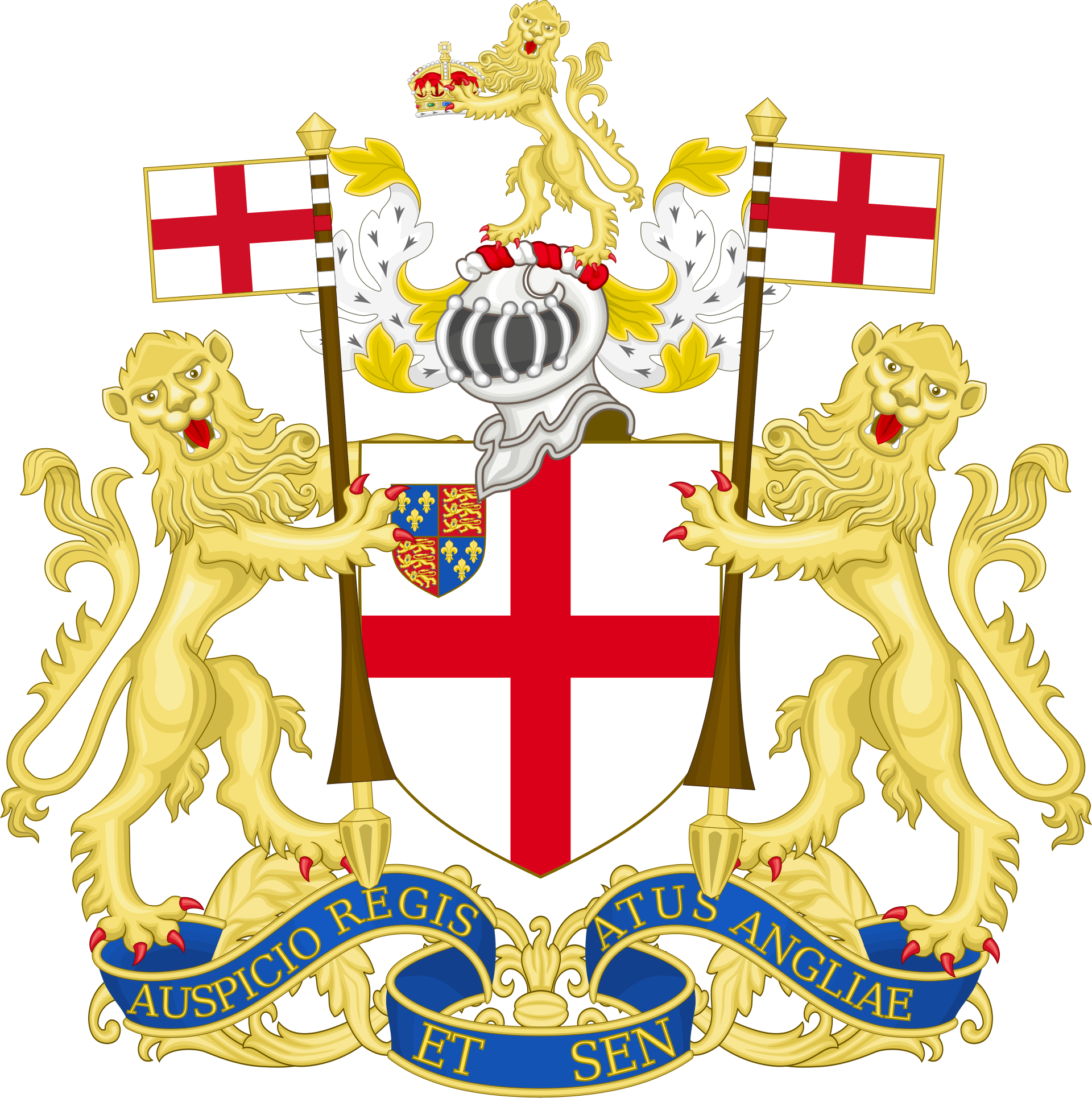
The East India Company's coat of arms. The motto "Auspicio Regis et Senatus Angliae" — "By the authority of the King and Parliament of England" — turned out to be prophetic: Parliament eventually took the whole Company for itself. (Wikimedia Commons, public domain)
Why a "Company" at All: Spices, Risk, and the Mathematics of Voyages
At the end of the sixteenth century, spices — pepper, cloves, nutmeg, cinnamon — were something between a luxury good and a currency. Europe bought them through a long chain of middlemen, at the end of which sat the Portuguese, who had held a monopoly on the sea route around Africa since 1498. The margins on that route were astronomical: a cargo of nutmeg bought at the source sold in Europe at a profit of many hundreds of percent.
But sailing to Asia was also extremely risky. A voyage took two years or more, ships sank, crews died of scurvy, and one lost fleet could ruin an entire merchant consortium. The Dutch learned this firsthand in the 1590s: after the first successful expeditions, a frenzy of competition broke out among Dutch cities in the form of so-called "pre-companies" (voorcompagnieën), which bid up purchase prices in Asia against one another while driving down selling prices at home.
The solution to both problems — enormous risk and self-destructive competition — was financial, not nautical. What was needed was to spread the risk across a large number of investors and to merge the competitors into a single enterprise with a monopoly. That is exactly what London and Amsterdam did, each in its own way.
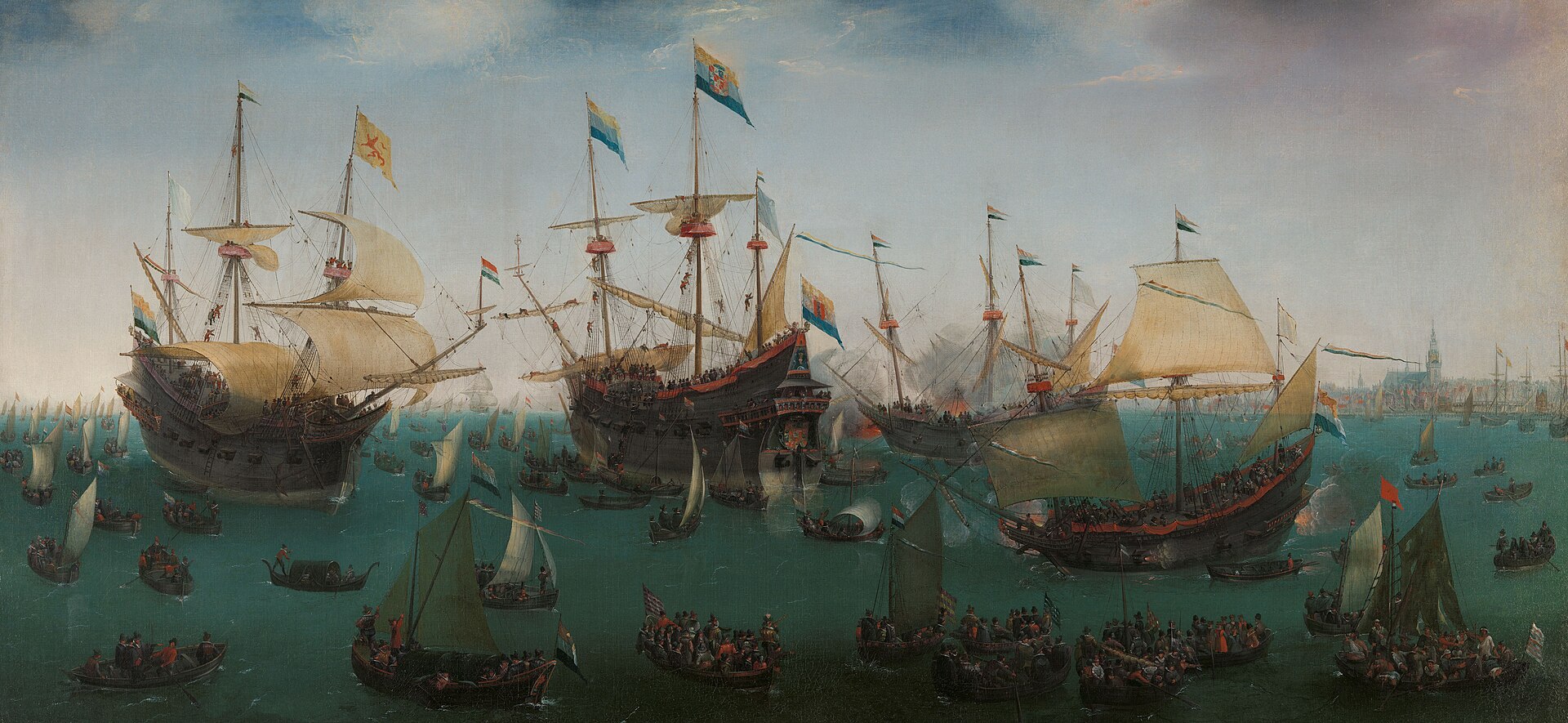
The return of the second Dutch expedition to Asia to Amsterdam in 1599, as captured by Hendrick Cornelisz Vroom. Jacob van Neck's expedition earned its investors returns of hundreds of percent — and set off a frenzy that led to the founding of the VOC three years later. (Rijksmuseum, public domain)
London, December 31, 1600
The English version came first. On the last day of 1600, Queen Elizabeth I signed a charter granting a group of 216 London merchants a fifteen-year monopoly on English trade with all lands "east of the Cape of Good Hope and west of the Strait of Magellan" — in practice, with all of Asia. Thus was born a company with the long name Governor and Company of Merchants of London Trading into the East Indies, which everyone soon simply called the East India Company.
From a financial point of view, though, the early EIC was nothing revolutionary. It worked the old-fashioned way: capital was raised for each voyage separately. Investors put up the money, the fleet sailed, came back (or didn't), the cargo was sold, the profit was distributed, and the venture was wound up on the books. The EIC's first twelve voyages were financed as twelve separate undertakings with separate subscriptions — historians call these terminable stocks. For its first expedition, the Company raised the equivalent of just over 700,000 guilders (the subscribed capital came to £68,373) — as we will see, roughly a tenth of what the Dutch raised two years later.
Truly permanent capital — the thing that makes a joint-stock company a joint-stock company — came to the EIC only with the charter of 1657, under Cromwell. More than half a century after its founding.
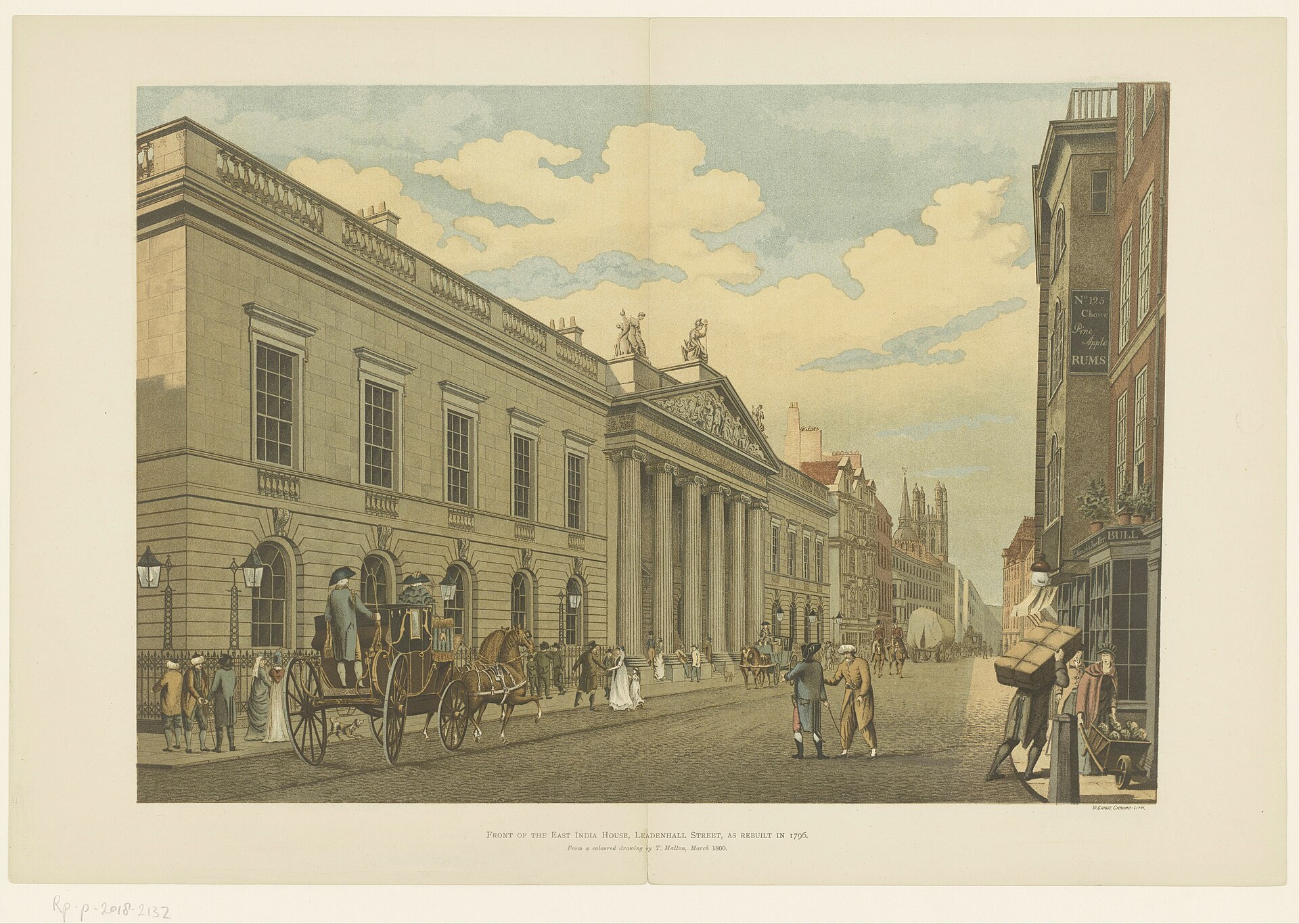
East India House on Leadenhall Street — the Company's London headquarters as rebuilt in 1796. From this building, India was governed at the height of the Company's power; today the site is occupied by the Lloyd's insurance building. (Rijksmuseum, CC0)
Amsterdam, March 20, 1602: The First IPO in History
The Dutch arrived two years later, but with a design that changed the world. The States General, led by Land's Advocate Johan van Oldenbarnevelt, merged the rival pre-companies into a single enterprise — the Verenigde Oostindische Compagnie, the United East India Company — and granted it a twenty-one-year monopoly on Dutch trade in Asia, including the right to build forts, conclude treaties with local rulers, and maintain its own armed forces.
The internal structure was remarkably well thought out for its time. The company consisted of six municipal chambers (Amsterdam, Middelburg, Enkhuizen, Delft, Hoorn, and Rotterdam), which appointed a central board of seventeen delegates — the famous Heeren XVII, the "Seventeen Gentlemen." Amsterdam, by far the largest chamber, was deliberately given only eight of the seventeen seats so that it could not dictate decisions on its own.
And then there is Article 10 of the founding charter, the reason the VOC is taught in every economics department: the share subscription was open to anyone, with no minimum or maximum investment. For the first time in history, any resident of the country could buy a stake in a great trading company — from a regent to a housemaid (and according to the surviving records, at least one housemaid actually did). Today we would say the VOC carried out the first initial public offering of shares — the first IPO.
The result? A subscription of 6,440,200 guilders — about ten times the capital of the EIC's first voyage. The Amsterdam chamber alone raised 3,674,945 guilders from 1,143 investors. Under the charter, the capital was locked in for ten years, which was itself a revolutionary step: until then, trading ventures had been liquidated after every voyage.
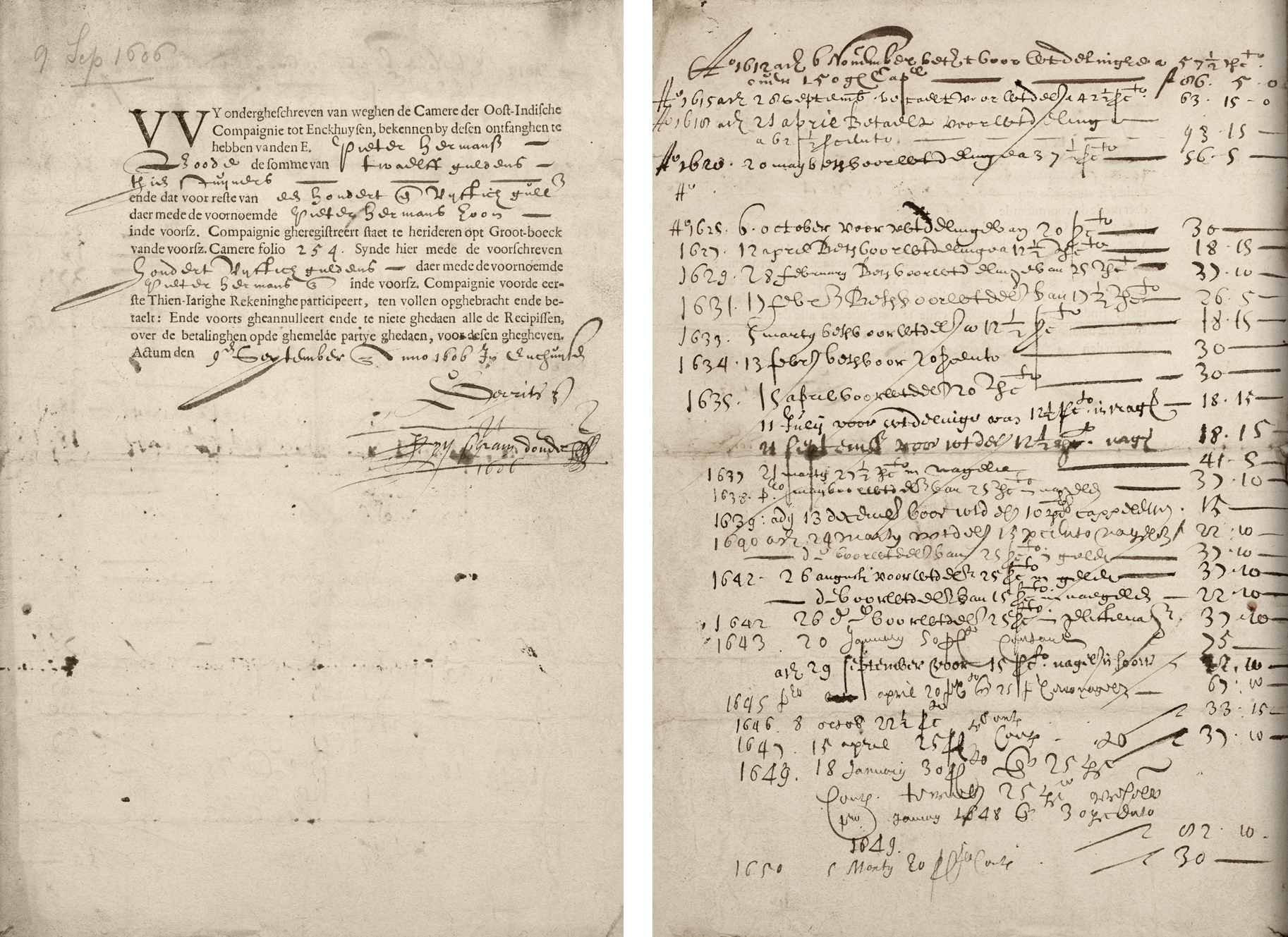
The oldest known VOC "share" — a receipt for a paid-up stake issued by the Enkhuizen chamber on September 9, 1606. It is kept today in the West Frisian Archive (Westfries Archief) in Hoorn. (Wikimedia Commons, public domain)
The Financial Revolution: The Exchange, Permanent Capital, and the First Short-Selling Ban
The 1602 charter contained one more inconspicuous provision: a procedure for the transfer of shares between persons. All it took was a visit to the bookkeeper of the relevant chamber to have the stake re-registered in the books. It sounded like an administrative detail — and it effectively created the first stock market in history. VOC shares began trading briskly on a secondary market almost immediately after the subscription, and from 1611 that market even had its own building: Hendrick de Keyser's exchange in Amsterdam.
The market behaved in surprisingly modern ways. Not only shares changed hands, but soon derivatives too — forward contracts and options. And where there is a market, there is also betting on a fall: as early as around 1609, the merchant Isaac Le Maire was organizing a bear syndicate to wager on a drop in VOC shares, and in 1610 the States General issued the first known ban on naked short selling in history (and had to proclaim it again when the charter was renewed in 1623 — enforcing regulations against speculators was a Sisyphean task even then).
The key moment for the history of corporations, however, came in 1612. Under the charter, a "general reckoning" was due after ten years, and investors were supposed to have the option of getting their capital back. But the money was sunk in ships, forts, and ongoing wars with the Portuguese. So on July 31, 1612, the States General simply suspended the liquidation article. The VOC's capital thereby became de facto permanent — for the first time in history, a private firm gained the prospect of an unlimited lifespan. An investor who wanted his money back could not get it from the firm; he had to sell his stake on the exchange to someone else. That is precisely the mechanism on which stock markets rest to this day.
And the dividends? Here one frequently repeated number needs correcting. Popular accounts claim the VOC paid "an average of 18% a year for nearly 200 years." The reality was bumpier: over its first two decades (1602–1622) it paid out a cumulative total of around 200% of the invested capital, or roughly 10% a year — and it even paid part of the early dividends in kind, namely in spices. After 1650, investor returns settled at a much more sober 3.5–4% a year. The legendary "18%" actually refers to profits as a share of revenue in the years 1630–1670, not to a dividend yield. It was still an extraordinarily steady money machine — just not the miracle that viral infographics make of it.
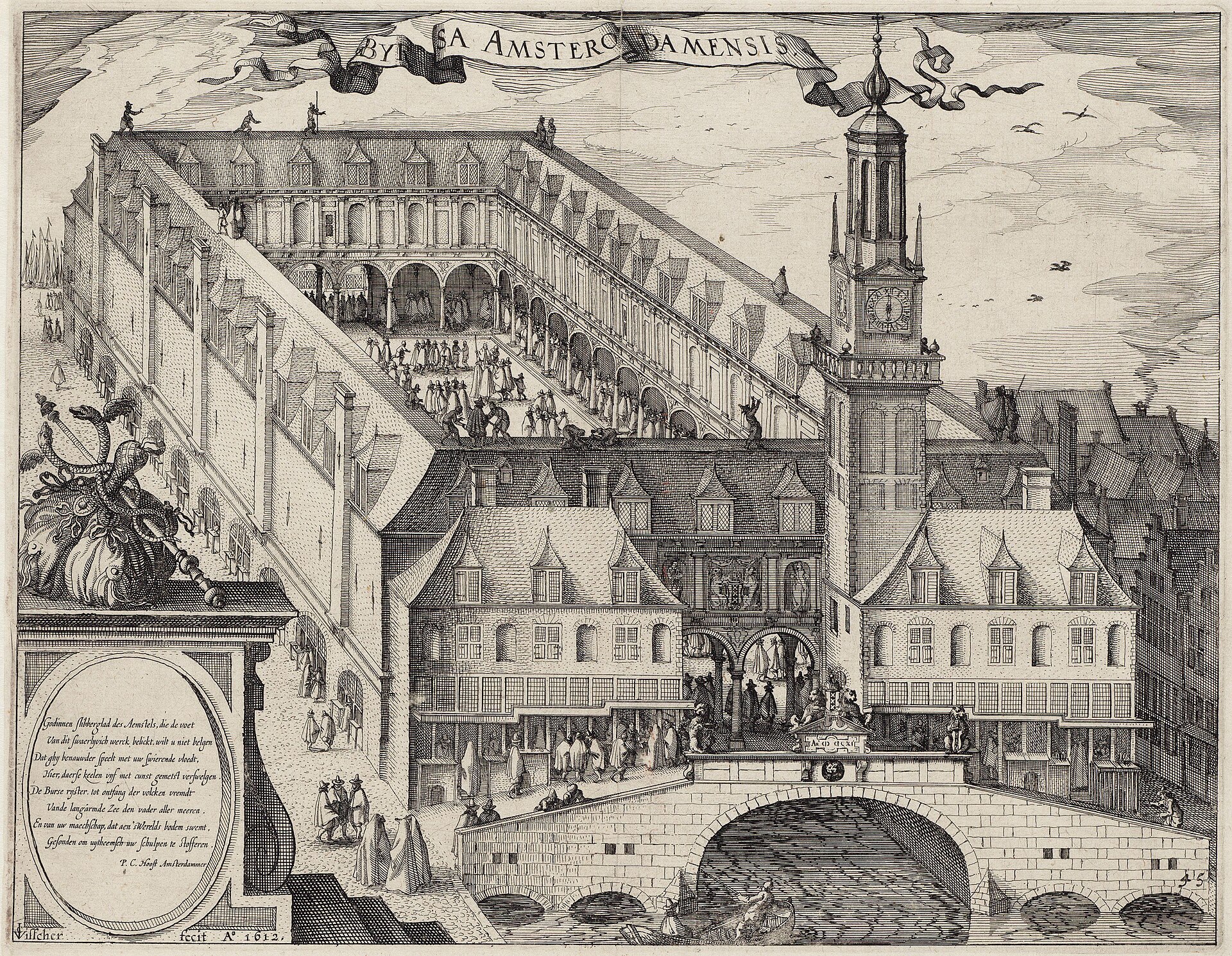
Hendrick de Keyser's exchange in Amsterdam, in an engraving by Claes Jansz. Visscher from 1612 — the first building in the world constructed primarily for trading shares. (Stadsarchief Amsterdam, public domain)
The Business in Numbers: Ships, People, Goods
Just how big was the enterprise? For the VOC, thanks to meticulous Dutch bookkeeping, we have figures that still make the head spin:
Between 1602 and 1796, the VOC made 4,785 voyages to Asia and carried more than 2.5 million metric tons of goods. Over the same period, its English competitor managed 2,690 voyages and roughly a fifth of the tonnage.
Over two centuries, around a million Europeans sailed to Asia on VOC ships — 59% of everyone who set out from Europe for Asia in that era. The surviving pay ledgers from 1633–1794 contain 774,200 embarkation records, corresponding, after deduplication, to 460,452 individual people.
In the eighteenth century, the VOC hired an average of about 7,000 new crew members a year, and up to 12,000 in peak years. Fewer than half of them were Dutch — the rest came mainly from the German lands, the southern Netherlands, and Scandinavia. The VOC was, in its way, the first multinational employer.
The EIC started more slowly but found gold mines of its own: first Indian cotton textiles (from some 5,000 pieces imported in 1613, the trade grew to 1.4 million pieces a year by 1694), then tea. By around 1720, goods from India made up roughly 15% of all British imports — and almost all of it passed through the EIC. Tea's share of the Company's trade shot up from 0.03% in 1670 to more than 10% by 1740; in the 1830s the EIC was importing about 30 million pounds (lb) of tea into Britain a year — roughly 13,600 metric tons. The product range also included silk, indigo, saltpeter (the key ingredient of gunpowder), salt, and porcelain — and from about 1730 to 1750 the Company was also heavily involved in the slave trade, a fact that corporate histories tend to leave out.
The Dark Side: Jan Pieterszoon Coen and Banda
The financial elegance of both companies is, however, only one side of the ledger; the other is written in blood. A monopoly on paper is just a word; a monopoly in practice was enforced with cannons.
The darkest chapter was written by the VOC in 1621. Nutmeg at that time grew in only one place on earth — the tiny Banda archipelago in present-day Indonesia, home to roughly 15,000 people who had lived for centuries as free traders and refused to sell exclusively to the Dutch. Governor-General Jan Pieterszoon Coen, author of the famous dictum that there could be "no trade without war, nor war without trade," decided to settle the problem once and for all: he ordered the conquest of the entire archipelago. What followed was a massacre that modern scholarship — including the Cambridge World History of Genocide — bluntly labels a genocide: thousands killed, 1,700 enslaved, village leaders executed by Japanese mercenaries, and the rest of the population deported or driven into the mountains and out to sea, where many perished. Of a population of 15,000, about 1,000 people remained on the islands. The VOC then settled the depopulated islands with planters and shiploads of slaves — and thereby won a world monopoly on nutmeg and mace.
Coen remains the subject of heated debate in the Netherlands to this day (the statue of him in his hometown of Hoorn faces recurring calls for removal). For the history of corporations, it is a cautionary reminder: the world's first publicly traded company was also a company that committed one of the first corporate genocides.
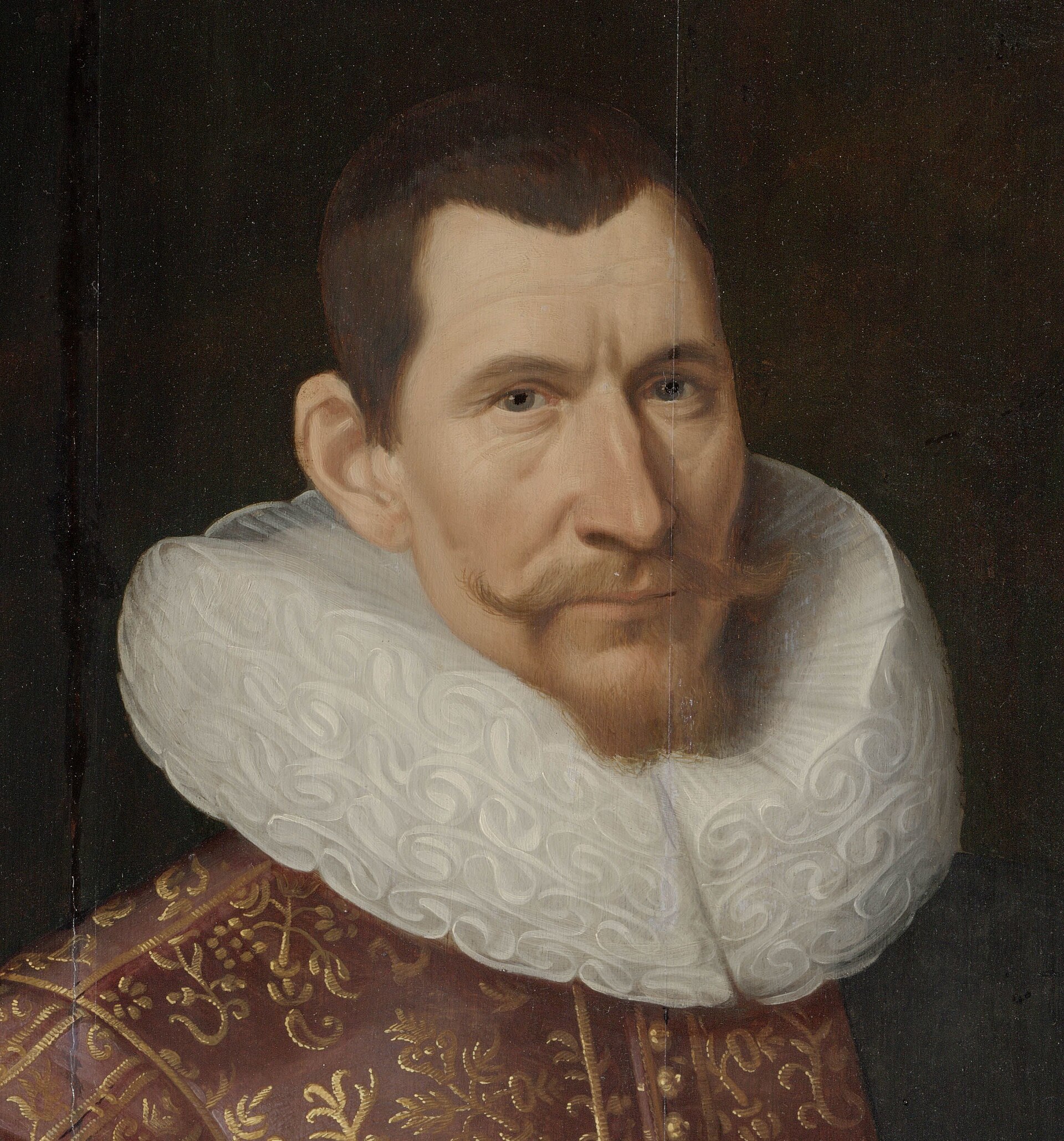
Jan Pieterszoon Coen (1587–1629), governor-general of the VOC and architect of the conquest of the Banda Islands. (Westfries Museum, public domain)
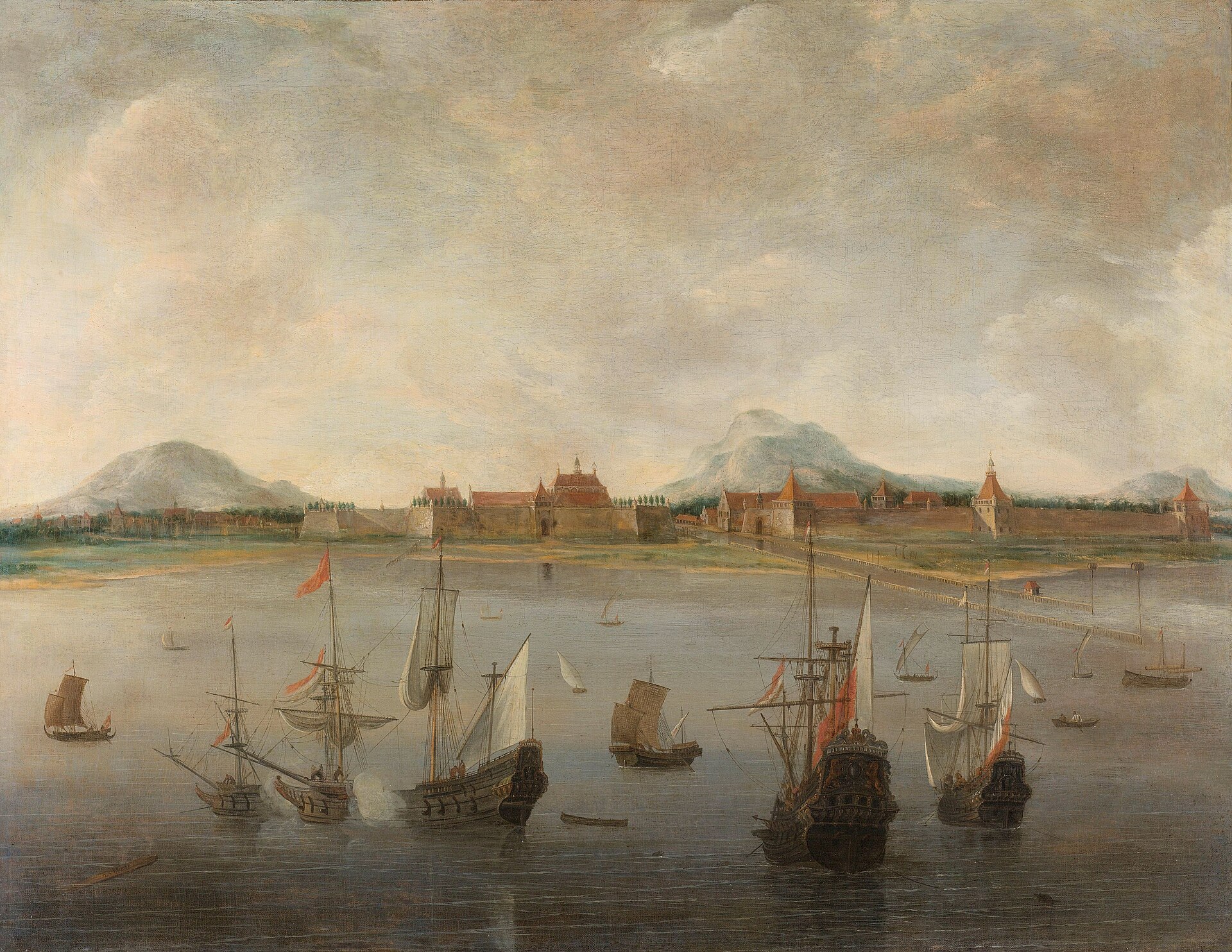
Batavia (present-day Jakarta), the VOC's Asian headquarters, founded by Coen in 1619 on the ruins of the town of Jacatra. From here the company ran a trading network stretching from the Cape of Good Hope to Japan for nearly two centuries. (Rijksmuseum, public domain)
The EIC: From Merchant to Ruler of Bengal
The British went through a similar transformation from trader to conqueror more than a century later — but on a grand scale. In the mid-eighteenth century, the Mughal Empire was falling apart, and the EIC, which until then had run fortified trading posts in India, began expanding into the power vacuum with its own army made up largely of Indian mercenaries — sepoys.
The turning point came on June 23, 1757, at Plassey. Robert Clive, a former Company bookkeeper who had worked his way up to military commander, defeated the vastly larger army of the Bengali nawab Siraj ud-Daulah with a force of 3,000. "Battle" is putting it strongly — the outcome was decided by the pre-arranged betrayal of the nawab's commander Mir Jafar, whom Clive rewarded by installing him on the throne as a puppet. The victories at Plassey and, seven years later, at Buxar (where about 7,000 Company troops defeated nearly 40,000 opponents) made the EIC the decisive military power in northern India.
Then, in 1765, the Mughal emperor granted the Company the diwani — the right to collect land revenue in Bengal, Bihar, and Orissa, a region of some 30 million people. From that moment on, the EIC was effectively a sovereign state: a private firm headquartered on London's Leadenhall Street ruled more people than lived in the British Isles, and its shareholders voted on the tax policy of a foreign land. Contemporary observers were fascinated that a vote at the general meeting could simply be bought — all it took was buying shares.
What such rule looked like in practice was shown by the very first great test. In 1769–1770, crop failure struck Bengal, followed by a famine — one of the worst in history. Traditional estimates spoke of up to 10 million dead — a third of Bengal; modern historians (Rajat Datta, Tim Dyson) revise those figures down to "at least one to two million," which changes little about the horror of the situation. What matters is what the governing firm did: in the middle of the famine, the EIC's council raised taxes by 10% to meet revenue targets, and some Company employees made money on the side speculating in grain. Adam Smith, otherwise the apostle of free trade, publicly condemned the Company for precisely this: a monopoly firm in the role of a state is, in his view, the worst of both worlds.
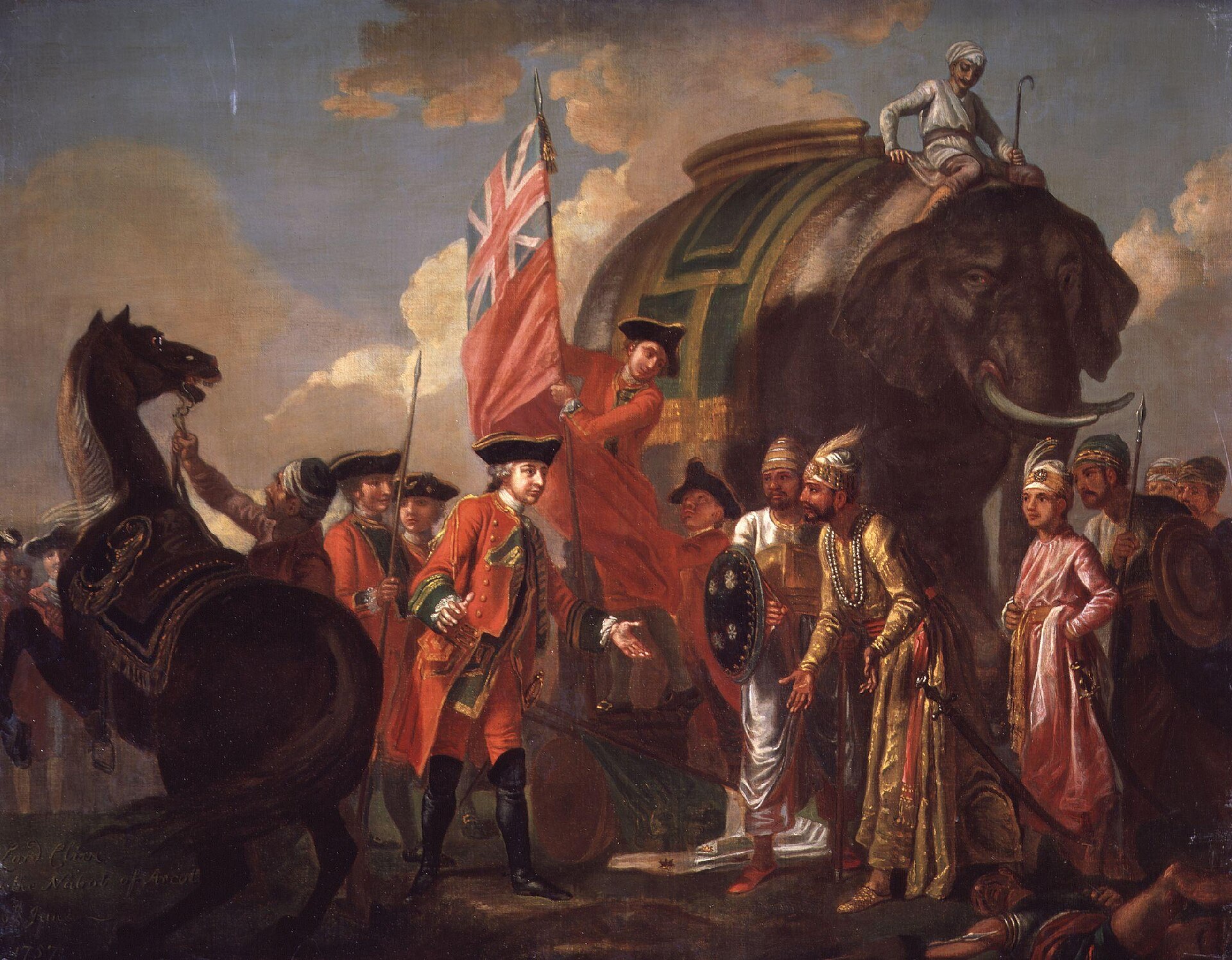
Robert Clive and Mir Jafar after the Battle of Plassey (1757), in Francis Hayman's painting. The betrayal that founded an empire: Mir Jafar got the throne, the EIC got Bengal. (National Portrait Gallery / Wikimedia Commons, public domain)
1772–1784: History's First "Too Big to Fail"
And now the part that will sound familiar to readers of the financial pages. The Bengal windfall inflated EIC shares into a speculative bubble; but the famine-ravaged province stopped generating the expected tax revenues, warehouses in London were drowning in unsold tea, and in 1772 a credit crisis broke out in London and Amsterdam. The Company, indebted to the Bank of England and to the state alike, suddenly could not meet its obligations.
Had it fallen, it would have taken much of London's financial system down with it — along with the state budget, which had grown accustomed to its payments. The British government thus faced a decision that governments have faced countless times since: let it fail, or bail it out? Lord North chose the bailout. Parliament set up two committees of inquiry and in 1773 passed a pair of laws: the Loan Act lent the Company £1.4 million of public money, and the Regulating Act, in exchange, subjected its administration to state oversight for the first time — creating the post of governor-general of Bengal with a council, and declaring the supremacy of the state over the Company's territories. It was history's first great state bailout of a private firm, complete with the classic "too big to fail" logic and the classic condition of "money in exchange for regulation."
Part of the rescue package was the Tea Act, meant to help the Company sell off its tea surpluses by allowing it to export directly to the American colonies. Everyone knows the result: on December 16, 1773, Boston colonists dumped a cargo of the Company's tea into the sea, setting off the chain of events that led to the American Revolution. The Boston Tea Party was not a protest against tea, but against the monopoly of a politically favored corporation.
From then on, regulation only tightened. Pitt's India Act of 1784 established a government Board of Control with the power to direct the Company's policy in civil, military, and revenue matters — creating a system of dual government that lasted until 1858. And from 1788 to 1795, Britain also went through its first great trial of a corporate executive: former governor-general Warren Hastings was impeached before the House of Lords for corruption and abuse of power in India. The prosecution was led by Edmund Burke, whose speeches on the accountability of power to the governed are classics of political thought. After a seven-year trial, Hastings was acquitted — and financially ruined, left with debts of £70,000. That, too, sounds familiar.
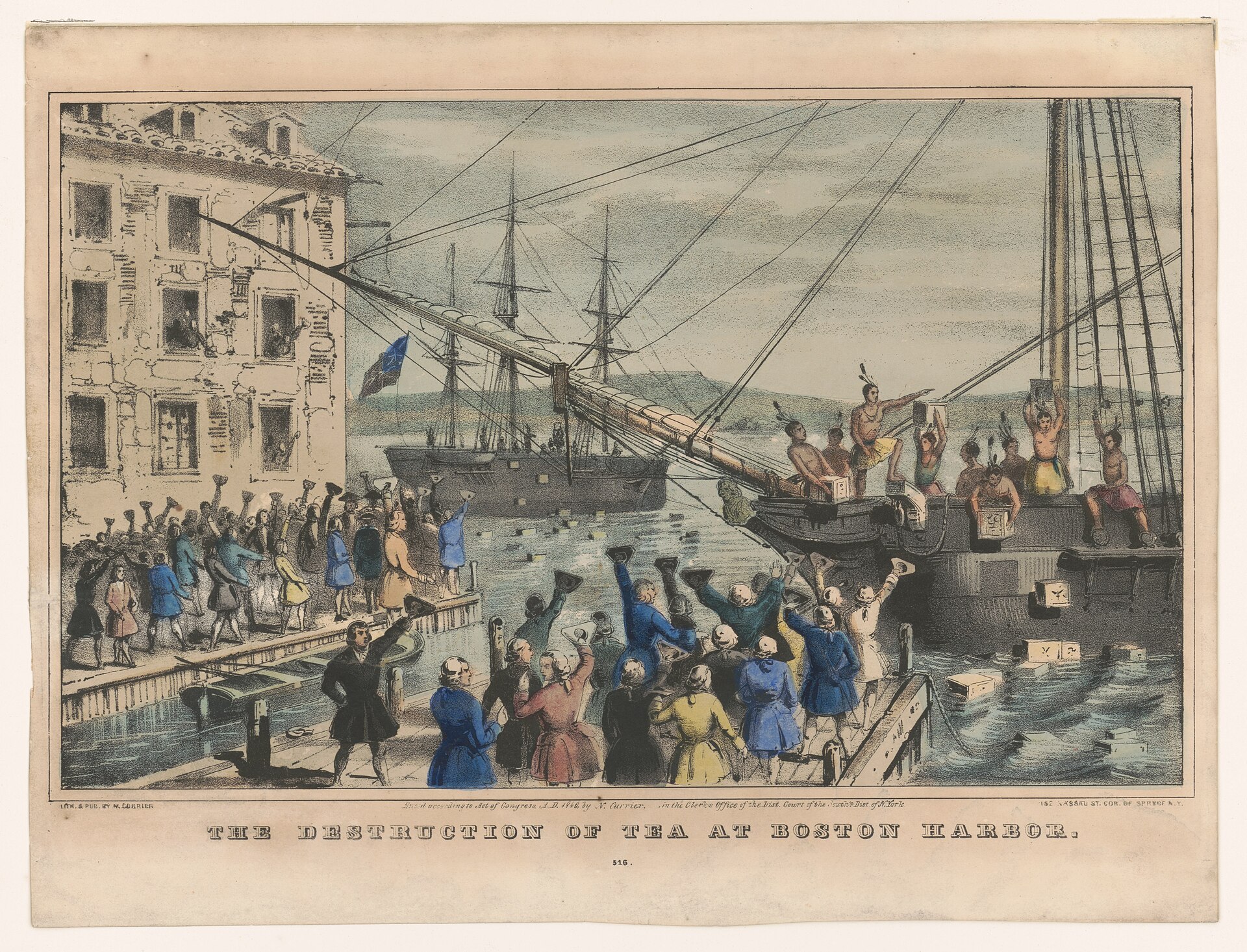
"The Destruction of Tea at Boston Harbor" — Nathaniel Currier's lithograph (1846). A cargo of East India Company tea at the bottom of the harbor, as a protest against the tax privileges of a monopoly corporation. (Library of Congress, public domain)
Tea, Opium, and the Most Cynical Business Model of the Nineteenth Century
After the loss of the American market, the center of gravity of the EIC's business shifted decisively to tea from China. But there was a balance-of-payments problem: China had no interest in European goods and wanted silver for its tea. The Company found a solution that still serves as a textbook example of commercial cynicism: opium. In Bengal, which it ruled, it set up a monopoly on the cultivation and processing of opium, which then flowed into China through nominally "independent" private traders — in defiance of the Chinese ban. Smuggling grew from about 4,000 chests a year around 1800 to more than 40,000 chests in 1839. The silver earned from opium paid for the tea; the tea paid the dividends; the duties on tea filled the British treasury.
When the Chinese government tried to stop the drug trade, the Opium Wars followed (1839–1842 and 1856–1860), and with them a humiliation of China that Chinese historiography to this day calls the beginning of the "century of humiliation." The First Opium War was no longer formally waged by the EIC — it had lost its monopoly on the China trade in 1833 — but the opium business model was built and operated by the Company, and its Bengal opium fields kept supplying it.
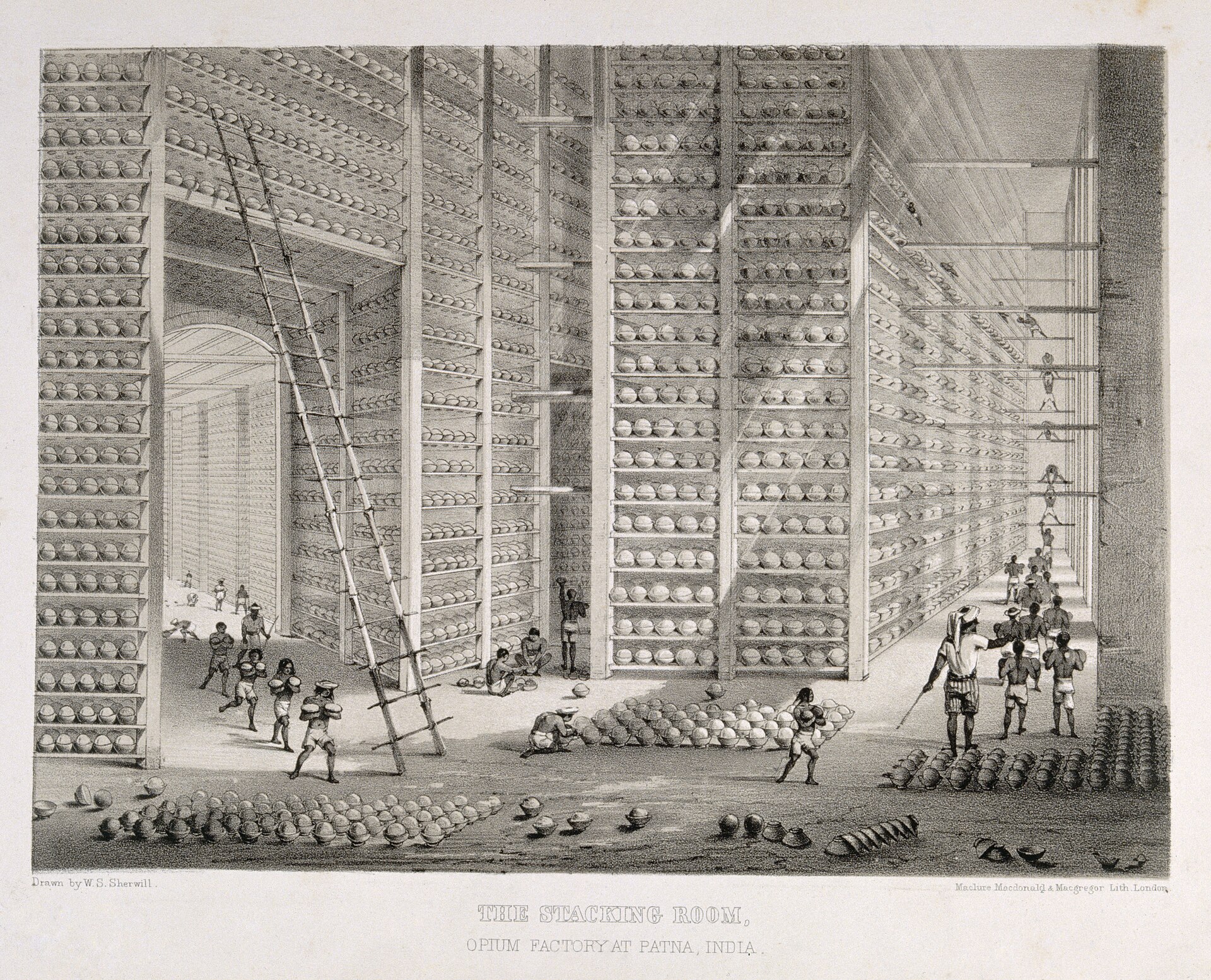
The stacking room for opium balls at the Company's factory in Patna, lithograph after a drawing by W. S. Sherwill (around 1850). The industrial scale of the trade that paid for Britain's tea. (Wellcome Collection, public domain)
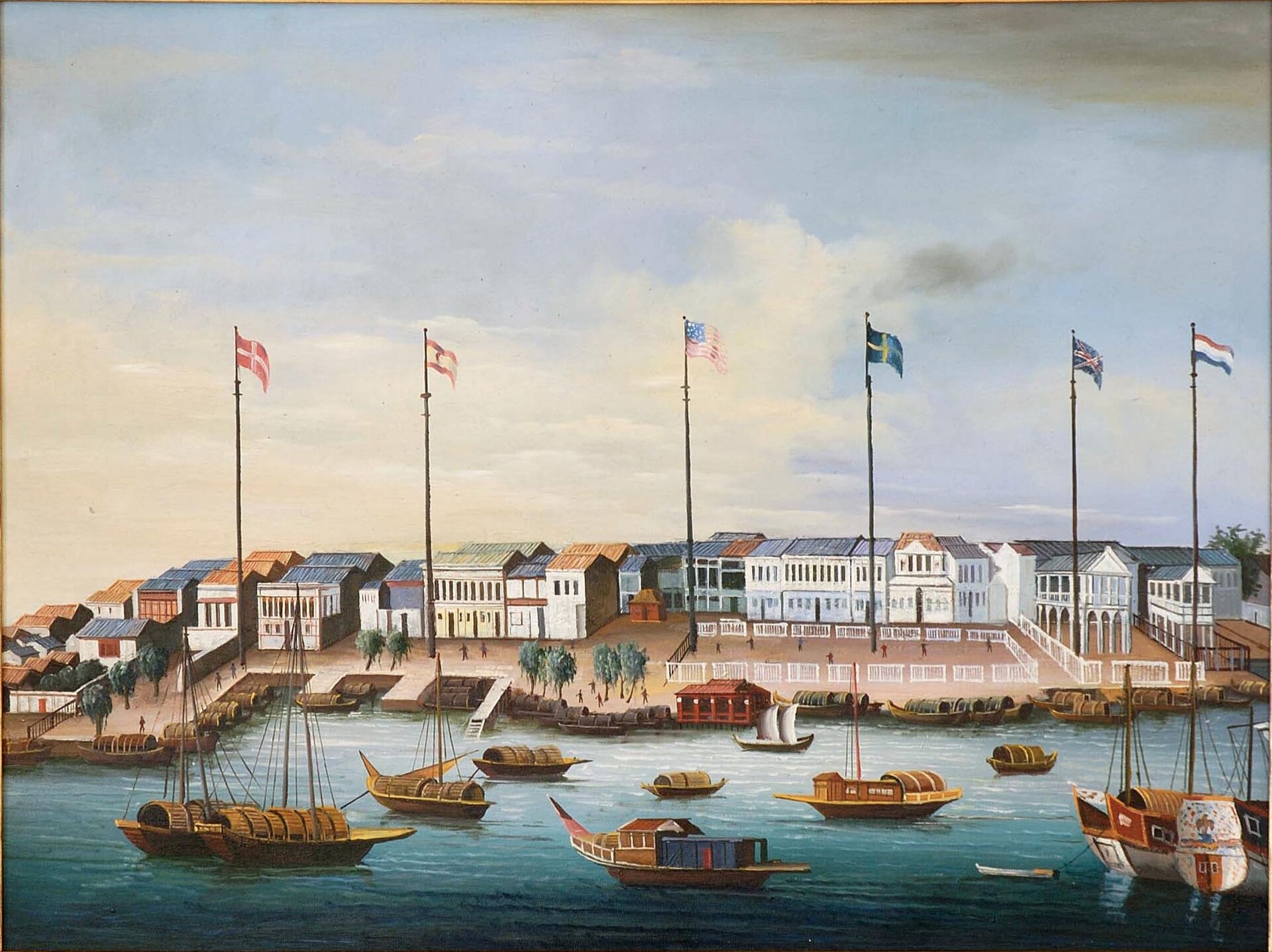
The "Thirteen Factories" in Canton (Guangzhou) around 1805 — the only place where European merchants were allowed to operate on Chinese soil. Under the flags of, among others, Britain, the Netherlands, and the young United States. (Wikimedia Commons, public domain)
The End of the VOC: The Initials Were Said to Stand for "Vergaan Onder Corruptie"
The Dutch colossus, meanwhile, was quietly rotting from within. After 1670, profits declined: spices grew cheaper, competition increased, and conditions hardened in the Asian markets where the VOC had once dictated prices. Corporate culture obliged — salaries of employees in Asia were miserable, and everyone from clerk to governor supplemented their income by smuggling privately at the firm's expense. In the Netherlands it was said that the initials VOC really stood for Vergaan Onder Corruptie — "Perished Through Corruption."
The mortal blow came with the Fourth Anglo-Dutch War (1780–1784). The British sank or captured half the VOC's fleet and cut it off from Asia; the war cost the company an estimated 43 million guilders and by 1784 had wiped out its assets. Years on a drip feed of state subsidies followed (roughly 58 million guilders in 1784–1790 alone). When the old Dutch Republic fell to the French invasion in 1795, the new Batavian Republic took over the VOC along with its debts — and simply let its charter expire on December 31, 1799. The world's first joint-stock company did not end in a stock-market crash, but in nationalization: the state took over the assets, the forts, the colonies — and 120 million guilders of debt, which Dutch taxpayers ultimately paid. That, too, was a bailout of a kind — just a posthumous one.
The End of the EIC: Rebellion, Nationalization, and the Last Dividend
The British Company outlived its Dutch rival by three quarters of a century, but its end followed a similar script: the state stripped it of one function after another until nothing was left.
The Charter Act of 1813 took away its monopoly on trade with India. The Charter Act of 1833 took the monopoly on Chinese tea as well — and ended all of its commercial activity outright. The world's largest trading firm became a purely administrative agency: it no longer sold anything, merely governed India on the state's behalf and collected a guaranteed dividend for doing so. A corporate shell with an army.
The end came with the Sepoy Rebellion of 1857 — a mutiny of the Company's Indian soldiers that grew into the greatest anti-colonial uprising of the century. Britain suppressed it with brutality, but the political verdict was unambiguous: the experiment with a firm in the role of a state was over. The Government of India Act 1858 transferred all of the Company's administration, territory, and armed forces to the Crown; India became the British Raj under direct rule, headed by a Secretary of State for India. The state went on paying shareholders a guaranteed dividend out of Indian taxes — the private firm no longer ruled, but the colonized went on paying its shareholders for another sixteen years.
The last word came with the East India Stock Dividend Redemption Act 1873: the state bought out the shares, and on June 1, 1874, after 274 years, the East India Company quietly ceased to exist. The Times wrote at the time that the Company "accomplished a work such as in the whole history of the human race no other trading Company ever attempted, and such as none, surely, is likely to attempt in the years to come." It was meant as a tribute; today it reads more like a warning.
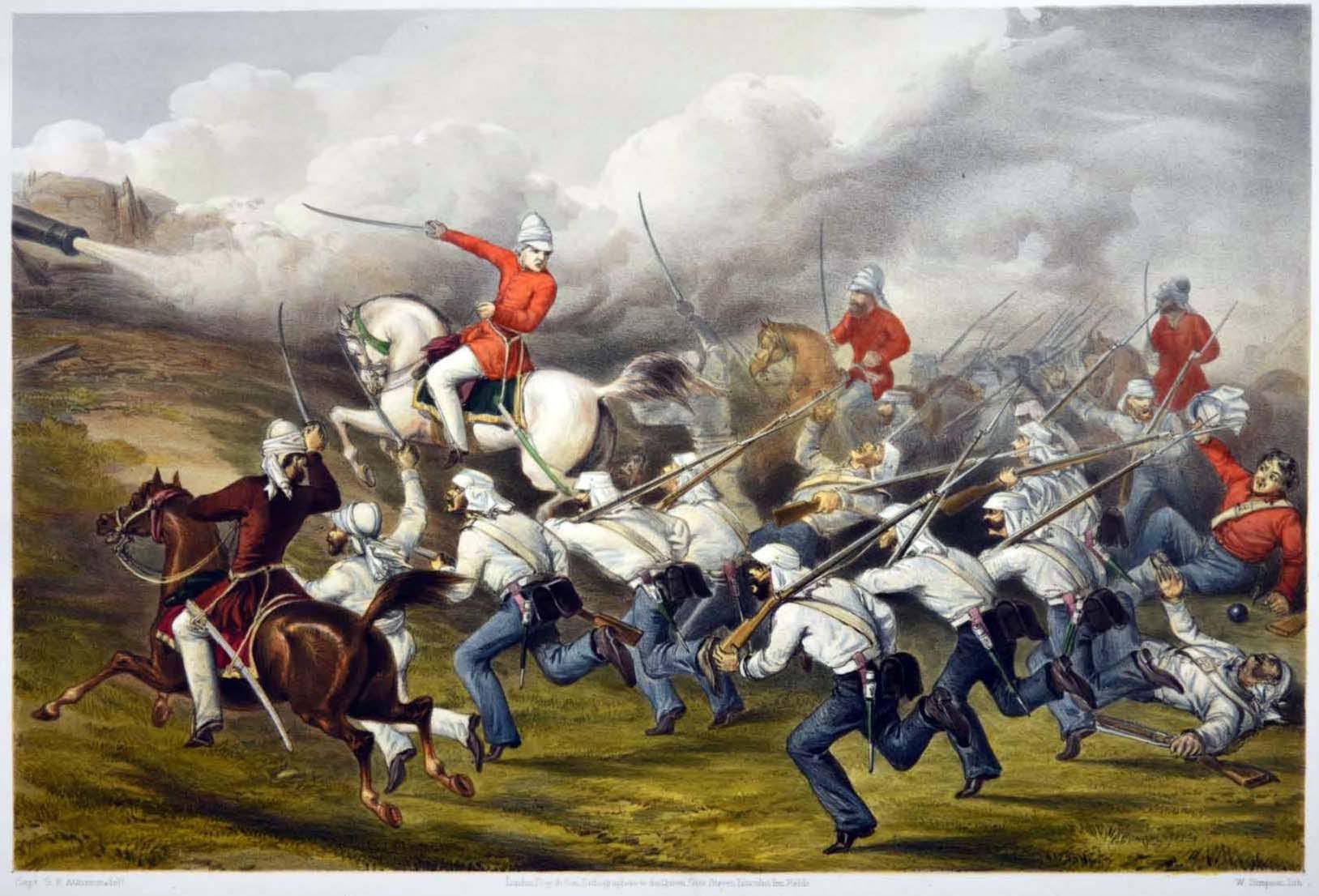
British troops attacking at Badli-ki-Serai before Delhi in 1857, a contemporary lithograph after G. F. Atkinson. The Sepoy Rebellion ended the Company's rule over India. (Wikimedia Commons, public domain)
The Legacy: What They Left Behind (and the $7.9 Trillion Myth)
The tally: the VOC lasted 197 years, the EIC 274. What remains of them?
Financial DNA. The joint-stock company with permanent capital, publicly traded shares, a secondary market, dividend policy, the separation of ownership and management, the regulation of speculation — all of it came together for the first time in Amsterdam between 1602 and 1612. Every stock exchange today is a distant descendant of the courtyard behind Hendrick de Keyser's building.
A political lesson. The EIC put on full display everything we still fear about corporations today: regulatory capture (dozens of MPs sat in Parliament holding Company shares or pensions), privatized violence, a bailout paid for by taxpayers, executives on trial for corruption, and accounting in which profits were privatized and losses — including famines — were socialized. William Dalrymple aptly observes in his book The Anarchy that the EIC's most enduring legacy is the very idea that a corporation can be more dangerous than a state.
And that army? As for the popular claim that in 1803 the EIC had an army of 260,000 men, "twice the size of the British Army," let's be honest: contemporary parliamentary returns show over 190,000 men in 1805 and over 225,000 in 1815; the figure of 260,000 appears in the literature more as a loosely cited upper estimate of the peak. Even the sober numbers, though, mean that a private firm commanded one of the largest standing armies of its day.
And while we're on the subject of myths: an infographic circulates around the internet claiming that at the height of tulip mania in 1637 the VOC was "the most valuable company of all time," worth $7.9 trillion in today's dollars. The number is nonsense. It was concocted in 2017 by compounding several botched conversions; the VOC's actual market capitalization in 1637 was about 19.3 million guilders, which, according to the price data of the Royal Netherlands Academy of Arts and Sciences, corresponds to on the order of hundreds of millions of today's euros — about 35,000 times less than the meme claims. The VOC was not "worth more than Apple, Google, and Amazon combined." It was something more interesting: a firm that did not earn its value on the exchange but enforced it with cannons — which is exactly why it cannot be compared with today's companies at all.
The East India companies invented the tools without which the modern economy would not exist. And at the same time, they remain the starkest case study of what happens when those same tools slip their leash. Both are worth remembering — especially at a time when we are once again debating firms more powerful than states.
Sources
Books
William Dalrymple: The Anarchy: The Relentless Rise of the East India Company. Bloomsbury, 2019.
Nick Robins: The Corporation That Changed the World: How the East India Company Shaped the Modern Multinational. Pluto Press, 2nd ed., 2012.
John Keay: The Honourable Company: A History of the English East India Company. HarperCollins, 1991.
Lodewijk Petram: The World's First Stock Exchange. Columbia University Press, 2014.
Academic and primary sources
Giuseppe Dari-Mattiacci, Oscar Gelderblom, Joost Jonker, Enrico Perotti: The Emergence of the Corporate Form — Journal of Law, Economics, and Organization 33(2), 2017 (working paper, Yale Law School). Founding capital of the VOC and EIC, permanent capital in 1612, the birth of the stock market.
Gerard Koot: The VOC, the Dutch East India Company, 1602–1799 — University of Massachusetts Dartmouth. Dividends, the Fourth Anglo-Dutch War, the end of the VOC.
Oxford Global Capitalism Project: Case Study #33 — The English East India Company. Plassey, the diwani, the Bengal famine, the Charter Acts.
The National Archives (UK): Records relating to the East India Company. The 1772 crisis, the Regulating Act 1773, the £1.4 million loan, the India Act 1784, the Charter Acts of 1813 and 1833.
UK Parliament, Living Heritage: Parliament and the East India Company and East India Company and Raj 1785–1858.
Lodewijk Petram: The world's first IPO — worldsfirststockexchange.com. The 1602 subscription, Article 10 of the charter, the Amsterdam chamber.
Matthias van Rossum et al.: Charting Lives and Careers: Enriched Data About the Dutch East India Company's Eighteenth-Century Workforce — Journal of Open Humanities Data, 2024. VOC pay ledgers, crew numbers.
Cambridge University Press: Genocide in the Spice Islands — in: The Cambridge World History of Genocide, vol. II, 2023. The conquest of the Banda Islands, 1621.
National Army Museum (UK): Armies of the East India Company. Plassey, the size of the army, the rebellion of 1857.
Encyclopedias and other sources
Encyclopaedia Britannica: East India Company, Dutch East India Company, Government of India Acts.
World History Encyclopedia: Trade Goods of the East India Company. Trade volumes in textiles, tea, and opium.
Wikipedia: East India Company, Dutch East India Company, Great Bengal famine of 1770, Dutch conquest of the Banda Islands, East India Stock Dividend Redemption Act 1873.
Michael Hennigan: Claim that Dutch East India Co was most valuable firm in history not credible — Finfacts, 2018. Debunking the $7.9 trillion valuation myth.
Was this article helpful?
Comments
No comments yet.